WHEEL TALK

Anatomy of a Wheel

Don’t be left in the dust when it comes to shopping for wheels, educate yourself to better understand terms like ‘How many spokes’ or ‘center bore’.
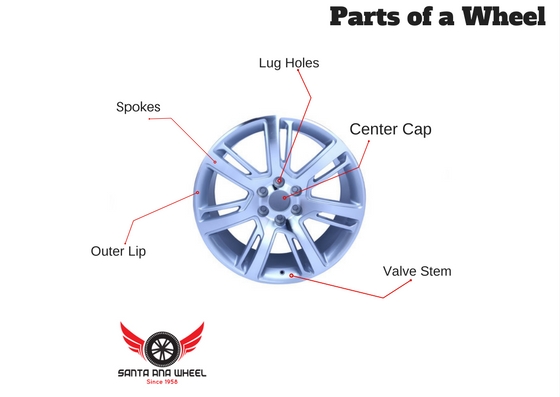
Barrel

The biggest part of a wheel is the structure or barrel. This looks like a tube and might be short or long. This part is what allows a tire to be fitted on, usually knowing the size of the barrel Is not needed as Original sizes stay the same.

Lip

The outer lip if the wheel is the as the name states, the outer edge. The outer lip is the part that is most likely bent when a wheel hits a pothole and the most repairable area. Technically the lip can be as big or deep until it meets the face of the wheel.

Valve Stem

A valve stem is where tire pressure is monitored, a small 1-2 inch metal stem somewhere on the outer edge of the wheel. Tire valve stems come in three different types depending on the type of vehicle: Snap-in, Snap-in for High Pressure, and metal clamp in.

Spokes

Besides the size, spokes are what make individual wheels unique and stand out from each other, or the most “cosmetic” aspect of wheels and rims. For example, 90% of steel rims don’t have spokes, just full on metal. Spokes are the pieces that hold the wheel together from the outer edge to the center, and the designs can be super basic or intricate. Spoke design usually begins with how many there are, how thick they are, and how they meet the edge of the wheel. For example, if they veer out to a ‘Y’ shape, they are called Y spokes.

Center Cap

Smack dab in the center of the wheel is the center cap, where the spokes touch. The center cap is removable, except on steel rims. The purpose of the cap is to cover the hole in the center and protect the lug nuts. A wheel can move without a cap with no problem, generally, a center caps purpose is to have the OEM logo and make the wheel look complete.

Lugs Holes/Nuts

Lug holes are the holes that the center cap covers, in which lug nuts go into to hold the wheel together. Wheels can have 4, 5, 6, or 8 lug holes. The term ‘Bolt pattern’ is the measurement from one bolt Is the opposite one across.

Centerbore

This is the big hole in the back of a wheel so it can slide onto the axle of the vehicle. A correct fitting center bore is extremely important, that’s why when buying aftermarket parts exact measurements and specs are key!
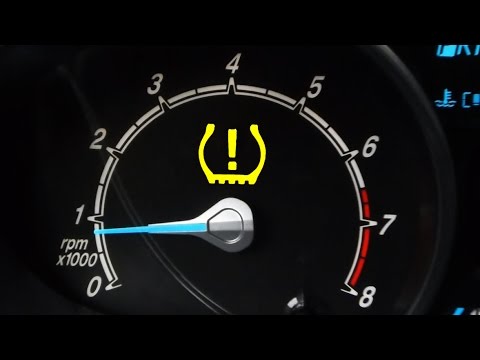
 

What is TPMS And Why Do I Need One? 

TPMS is a tire pressure monitoring system, the purpose it serves is pretty self-explanatory from the name and pretty darn important too.
If your car is older than 2008, it most likely is without a TPMS system.

Regulations changed in 2000 when Firestone came under fire (no pun intended) for a series of tire blowouts, which resulted in 100 related deaths. As a result Congress enacted the TREAD act, which would force a TPMS system to be in place in all 2008 and later vehicles.

  • There are two different kinds of TPMS systems:

    Direct – Uses a physical sensor which is installed on all the wheels. When pressure from the tire drops below 25% of the specific manufacturers recommended pressure, the light on the dashboard will go on to check your tires. This is why if the light goes on, it is strongly recommended to fill those tires up! 
    Indirect – an indirect TPMS is linked to the Anti breaking lock system in the car, or ABS. When a tire is lower than the other 3, it will rotate at a slower pace. An indirect system measures the rotation, so it alerts you when one is moving slower.

Direct TPMS is always going to be more expensive due to having to replace these sensors every 5-6 years…about the life of new tires. OEM sensors are always going to cost more then aftermarkets, but luckily the industry is improving and manufacturing more sensors to fit more original vehicles. Direct options will also be susceptible to becoming useless to outside factors, such as corrosion on your wheels. Corrosion is caused by exposure to elements such as salt, which can eat away at material like chrome. With the wheel goes the sensor.

Happy Driving!

How to clean alloy wheels

What you will need:

  • Choose between a combo of cheap household cleaning  supplies:
    • Dawn dish soap and Baking Soda (Most recommended)
    • Lemon juice and soda 
  • A basic large sponge
  • A powerful water hose
  • Old toothbrush (optional for small crevices) 
  • Soft microfiber cloth (or regular towel) 

If you wish to use an actual wheel cleaner, feel free. We just find it is unnecessary and plain chemicals work fine.

The first thing to make sure is that your wheels are completely cool and not hot from driving. The heat can react with the chemicals and have a less than desired effect.

To loosen up the old dirt, grime, and a wheels worst enemy, brake dust, spray vigorously with a power hose. Try to get into the small crevices in the wheel, the more the brake dust is loosened, the easier it will be to remove later. 

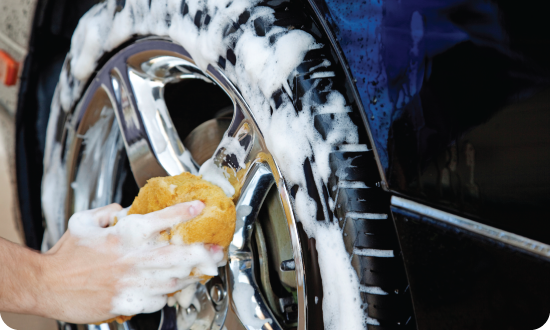
Combine Dawn dish soap and water in a bucket, (only about half a cup of Dawn) and mix well. Before scrubbing away with your sponge, soak it and carefully wipe away the dust and grime. Careful not to push too hard to grind the brake dust into the aluminum. Don't forget about the lug nuts, they can hide a lot of old caked on dirt.

Try using a soft toothbrush to reach into small slits. But don't push too hard! Some polished wheels may scratch easily. 

Once the wheel looks like most of the dirt is loosened, give it a good spray with the power hose. Wipe dry with a soft microfiber cloth, or a standard towel, but make sure to dry fully to not leave water spots. 

 fall-is-car-care-season-1

October is Officially Car Care Month: 6 Tips for Better Car Care

October is that sweet spot right after the long Summer vacations and right before the holiday madness hits. All your extra cash will be going to large dinners, holiday getaways, and of course gifts for loved ones.

The holidays has to be the worst time to be hit with an unnecessary automotive expense, namely due to lack of easy maintenance. Fall is also right before the winter temps drop way down, which can affect the way your car drives and performs, so Voilà October is deemed Car Care Month, although really one should check these items off for all the Winter months.

Most of these items are fairly inexpensive, certainly cheaper than a huge break down on the freeway, or worse, an emergency situation.

If you choose to take your car to a shop or have the experience to take care if it at home, Santa Ana Wheel recommends completing this list to avoid potential accidents and pricey emergencies!

  1. Fully Charged Battery: We suggest going to a trained technician to check the battery, as a wrong voltmeter reading could mean the difference of a healthy battery and a dying one. (A good reading is between 12.4-12.7 volts, anything lower requires a recharge). Testing the battery is one of the most vital items to check off the list, don’t ignore it! A dead battery in middle of the cold is not fun or affordable.

2.  Brakes: A brake check should really be done at least once a season (but let’s be honest we’ll do it once a year if we remember) but if you’re going to invest in auto maintenance on one thing,                this is it, especially if you live in a cold weather area. (Midwesterners I’m talking to you) A brake system such as the linings, rotors, and drums all should be inspected before driving on icy                  roads.

3. Tires: Here in sunny California the investment on snow tires aren’t needed, but your tires certainly shouldn’t be close to bald during the rainy season. You can measure the air pressure and                tread depth of your tires with a few simple tools, or take your car into a shop and spring for a tire rotation if you can’t invest into a whole new set. Either way, it’s a great investment on                        safety.

4. Heaters, Defrosters, and Wiper Blades: These items are essential to be in top shape during the cold months, regardless If you live in a dry area. Wiper blades should be replaced if the blade                leaves any smudges or streaks when swiping. If you live in a snowy region, snow wipers which prevent snow from building up are an option for extra safety.

5. Light me up: Check all headlights, turn signals, hazards, etc. to make sure they are in excellent working condition.

6. My mother always warned me to carry an emergency road kit in my car at all, times, with how much time we spend in the car, I’m surprised this isn’t a DMV requirement! No one wants to                think about an emergency like this happening, but you will be so relieved when you’re the prepared one. Here are some basic suggestions to put together your own:

Basic Emergency Road Kit:

  • First aid kit (Non-expired) 
  • Jumper cables (Every car should have these regardless) 
  • A blanket 
  • Flashlight with extra batteries 
  • Flares 
  • Pocketknife 
  • Bottled water (Alot)
  • Energy Bars